Rügen Island · Baltic Sea
Germany's most famous pier, white spa-town villas along Wilhelmstrasse and fine sandy beach beneath the high shore.
What makes Sellin special
Wilhelmstrasse is the heart of Sellin: an avenue of white spa-town villas with carved verandas, cafés and small shops, running straight towards the sea. At its end, the view opens out over the Baltic — and the stairway leads down to the famous pier. The Granitzhof is just a few minutes' walk away on Granitzer Strasse.
Sellin sits on the high shore between the Baltic Sea and Lake Sellin, surrounded by the beech forests of the Granitz. The village is well-kept and walkable — from the morning trip to the bakery to an evening stroll along the promenade, you won't need a car.
On your doorstep
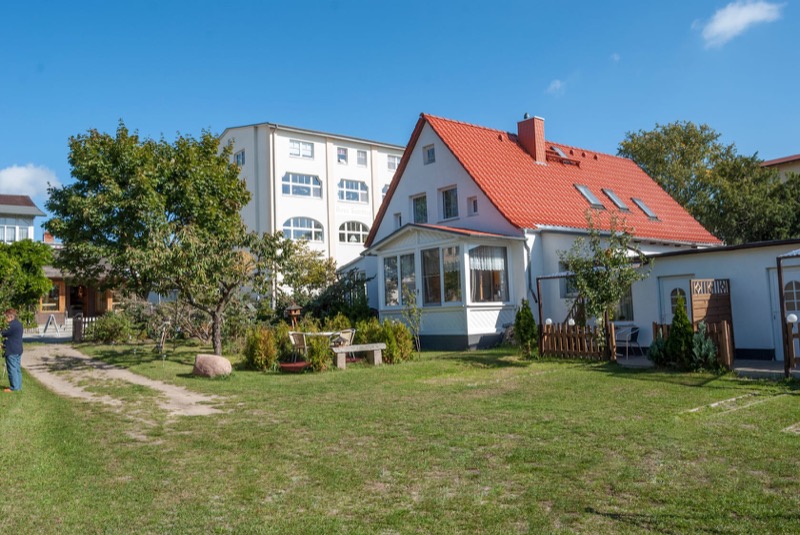
From the Granitzhof it is around 800 metres to the end of Wilhelmstrasse — where Sellin's pier reigns, its imperial-era pavilion the most photographed building on the island. Below the high shore: fine sandy beach with wicker beach chairs, lively with bathers in summer, wonderfully empty in winter.
To the south lies Lake Sellin with boat hire and the lakeside park; to the north the clifftop path leads through old beech forest all the way to Binz — and Granitzer Strasse itself points the way into the woods of the Granitz with its hunting lodge.
Day trips
Sellin lies in the middle of the island's south-east — the ideal starting point for Rügen's most famous sights.
The village landmark: the pier stretches 394 metres into the Baltic, with a restaurant in the historic pavilion and the diving gondola at its tip, which sinks to the seabed at the touch of a button — right at the end of Wilhelmstrasse.
The most visited palace in Mecklenburg-Western Pomerania sits enthroned in the beech forest between Sellin and Binz. The tower's cast-iron spiral staircase rewards you with a sweeping view over the island — just one stop away on the Rasender Roland.
Since 1895 the historic narrow-gauge railway has steamed across the island — Sellin has two stations of its own. Westwards it takes you to the hunting lodge, to Binz and Putbus; eastwards to Baabe and Göhren. Nostalgia on a regular timetable.
The white chalk cliffs of Jasmund National Park with the famous Königsstuhl are among Germany's best-known natural wonders — surrounded by UNESCO World Heritage beech forests. A good half hour away by car.
South of Sellin, the quiet Mönchgut peninsula opens up: lagoon bays, fishing villages such as Gager and Groß Zicker, plus the cliffs near Göhren — a paradise for cycling and hiking in the biosphere reserve.
The elegant neighbouring resort of Binz with its Kurhaus and promenade can be reached on foot along the clifftop path, by train or by car. Beyond it: the treetop walkway at the Natural Heritage Centre and the "Colossus of Rügen" in Prora with its documentation centre.
Rügen is a paradise for four-legged friends: designated dog beaches, wide forests and dog-friendly restaurants. Pets are welcome in all apartments and bungalows at the Granitzhof.
Overnight guests in Sellin pay a visitor's tax (Kurabgabe) and receive the resort's guest card in return — with discounts at many attractions and events. The visitor's tax can be conveniently paid online.
By car, the A20 leads over the Rügen causeway onto the island; from Bergen it is around 20 minutes. Rail travellers change in Binz or Putbus onto the Rasender Roland. High summer for beach days, spring and autumn for peace and clear air — and in winter the pier is almost all yours.
The loveliest place to stay
View apartments & book